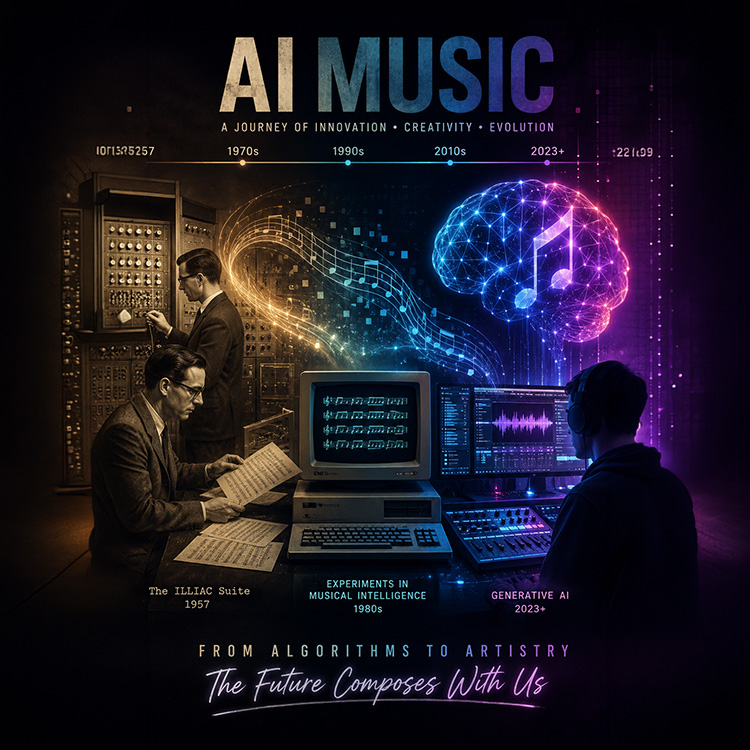
AI Music Isn't New It's Been Evolving for Nearly 70 Years
For many people, AI music seems like a sudden phenomenon that appeared overnight with platforms like Suno and Udio. Social media often treats it as if it sprang into existence in 2023. The truth is far more fascinating.
Artificial intelligence has been influencing music for nearly seven decades.
What we're witnessing today isn't the birth of AI music—it's simply the latest chapter in a long history of computers assisting composers, musicians, and producers.
The First AI Music Was Created in 1957
The roots of AI-generated music stretch back to the University of Illinois in 1957.
Researchers Lejaren Hiller and Leonard Isaacson developed what became known as the ILLIAC Suite, widely recognized as the first computer-generated musical composition. Using the ILLIAC computer, they programmed rules based on music theory and probability, allowing the computer to compose original sheet music.
There were no digital audio workstations.
No virtual instruments.
No machine learning.
Just mathematics, algorithms, and imagination.
It proved one important idea: a computer could participate in the creative process.
The Algorithmic Era (1950s–1970s)
The earliest decades of AI music focused on rule-based composition.
Researchers taught computers the fundamentals of harmony, rhythm, and musical structure. Instead of "learning" music, computers followed carefully written instructions to generate experimental compositions.
These works weren't intended to replace musicians they were academic explorations into how creativity could be expressed through computation.
The Mimicry Years (1980s–1990s)
As computing power improved, researchers began asking a different question:
"Can a computer compose in the style of great composers?"
Programs such as David Cope's Experiments in Musical Intelligence (EMI) analyzed works by Bach, Mozart, and other classical masters. Rather than relying solely on rigid rules, these systems examined existing compositions and generated convincing new pieces inspired by those styles.
For the first time, computers weren't just following instructions they were beginning to imitate artistic patterns.
The Machine Learning Revolution (2010s)
The next leap came with machine learning.
Instead of programmers defining every musical rule, neural networks learned directly from enormous collections of music. AI began recognizing patterns in melody, harmony, rhythm, instrumentation, and production techniques.
These advances also expanded into audio restoration, mastering assistance, stem separation, and intelligent music production tools that many professionals quietly adopted long before generative AI became a household term.
The Generative AI Explosion (2023–Present)
Today's AI music platforms represent the most visible stage in this decades-long evolution.
Tools such as Suno and Udio allow creators to generate complete songs—including vocals, lyrics, arrangements, instrumentation, and production—from a simple text prompt.
What once required university research labs and million-dollar computers can now be done from a laptop or smartphone in minutes.
This isn't the beginning of AI music.
It's the democratization of it.
Every Generation Faces New Technology
Throughout history, new technologies have been met with skepticism.
Electric guitars were criticized.
Synthesizers were dismissed as "fake."
Drum machines were said to destroy real drumming.
Digital recording was accused of ruining music.
Auto-Tune sparked endless debate.
Today, AI has become the newest target.
Yet history consistently shows that technology rarely replaces creativity it expands the ways creativity can be expressed.
AI Is a Tool, Not a Genre
A common misconception is that AI creates music on its own.
In reality, the quality of AI-generated music often depends on the person guiding it. Crafting effective prompts, refining arrangements, editing lyrics, selecting styles, mixing, and mastering all require creative judgment.
Just as a camera doesn't make someone a photographer, AI doesn't automatically make someone a musician.
It is another instrument one that still benefits from human vision, taste, and storytelling.
Looking Ahead
Whether you embrace AI music or remain skeptical, one fact is difficult to ignore:
AI has been part of music's evolution since 1957.
The technology has changed dramatically, but the underlying goal has remained remarkably consistent to explore new ways of creating music.
The conversation today shouldn't be about whether AI belongs in music. History has already answered that question.
The real discussion is how artists, producers, and listeners will use this technology responsibly, creatively, and ethically as the next generation of music continues to evolve
His official FIYA Music page is:
https://fiyaplatform.com/@AcemangMusic
I was honestly shocked by some of this too. But I suppose AI music was always in the making. People have always wanted computers to do more than write documents, crunch numbers, or build spreadsheets in Excel.
As long as we keep things in perspective, AI can be a magnificent creative helper.
I feel like a lot of the fear and even hatred around AI is purely emotional. People are reacting to what they think it means before understanding what it can actually do.
I don’t know about y’all, but my favorite cartoon growing up was The Jetsons.
What did you think Elroy was using? Lol.
I'll have to ask him about his experience with early AI tech