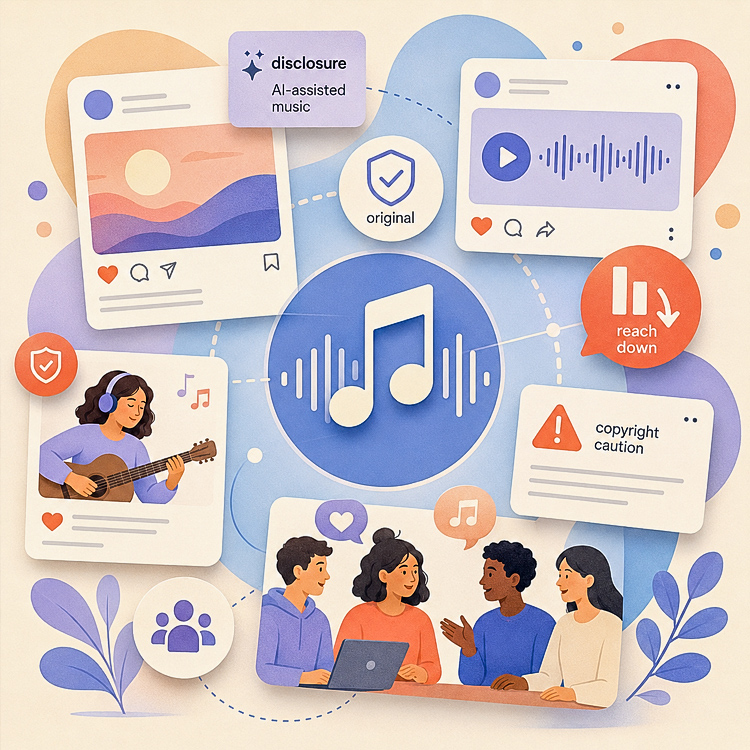
The short answer is no, not completely.
The major social platforms are not banning AI music across the board. But they are becoming much more careful about what kind of AI music content they allow, recommend, monetize, or push into feeds.
That is the important difference.
AI music itself is not the enemy. The problem is the flood around it: fake artist voices, uncleared remakes, copycat songs, low-effort uploads, recycled visuals, and anonymous content that feels like it was made only to game the algorithm. Platforms are not simply asking, “Was AI used?” They are asking, “Is this original, transparent, legal, and valuable to viewers?”
TikTok is a good example. TikTok allows AI-generated content, including AI audio and video, but realistic AI content needs to be labeled. The platform says using its AI-generated content label does not automatically reduce distribution if the post follows the rules. But that does not mean every AI music video will get shown. If a video feels misleading, impersonates a real artist, uses copyrighted material without permission, or looks like spam, it may get limited, removed, muted, or simply ignored by the recommendation system.
YouTube is moving in a similar direction. YouTube allows AI-generated music and gives creators ways to disclose altered or synthetic content. Disclosure alone is not supposed to kill reach or monetization. But YouTube also has rules around repetitive, mass-produced, or low-value content. So if someone uploads hundreds of AI songs with the same formula, the same visual template, and no real creative identity, that content may be treated as inauthentic.
Instagram and Facebook are also tightening the line. Meta has been adding AI labels across images, video, and audio when users disclose AI use or when systems detect AI signals. Facebook is also pushing harder against unoriginal content. That matters for AI music because a song may technically be new, but if the visuals, concept, hook, voice, or structure are copied from somewhere else, the platform may still see it as low-value or unoriginal.
This is where copyright gets messy fast.
For example, “Paradise City by Guns N’ Roses, but make it reggae” might sound like a funny prompt or a creative experiment. But to rights holders and platforms, that can look like a derivative work. If the song copies the melody, lyrics, hook, arrangement, or recognizable identity of the original, AI does not magically make it legal. It could be claimed, muted, demonetized, removed, or buried. The same goes for “make a song that sounds like Drake,” “give me a Taylor Swift-style vocal,” or “rewrite this hit song in a new genre.” The closer it gets to a protected artist or song, the higher the risk.
The right way forward is not complicated, but it does require discipline. Disclose AI use when required. Do not clone real artists without permission. Do not build songs directly from famous copyrighted material. Avoid fake artist identities. Make the work feel like it belongs to a real creator, a real project, or a real community.
AI music and AI content are increasingly being treated like “AI slop,” but that label is too lazy. AI music is not automatically slop. Slop is careless content. Slop is mass-produced content with no soul, no context, no credit, and no community behind it.
The future is not just uploading more. The future is building together.
Communities will matter more than shortcuts. Platforms may filter harder, but creators who are honest, original, and connected to real listeners still have a path forward.
What do you think: are the platforms protecting creativity, or are they unfairly burying AI music before it has a chance? Drop your thoughts in the comments.
I bet ya they'll stop supporting them soon. No Ai music. 🤯