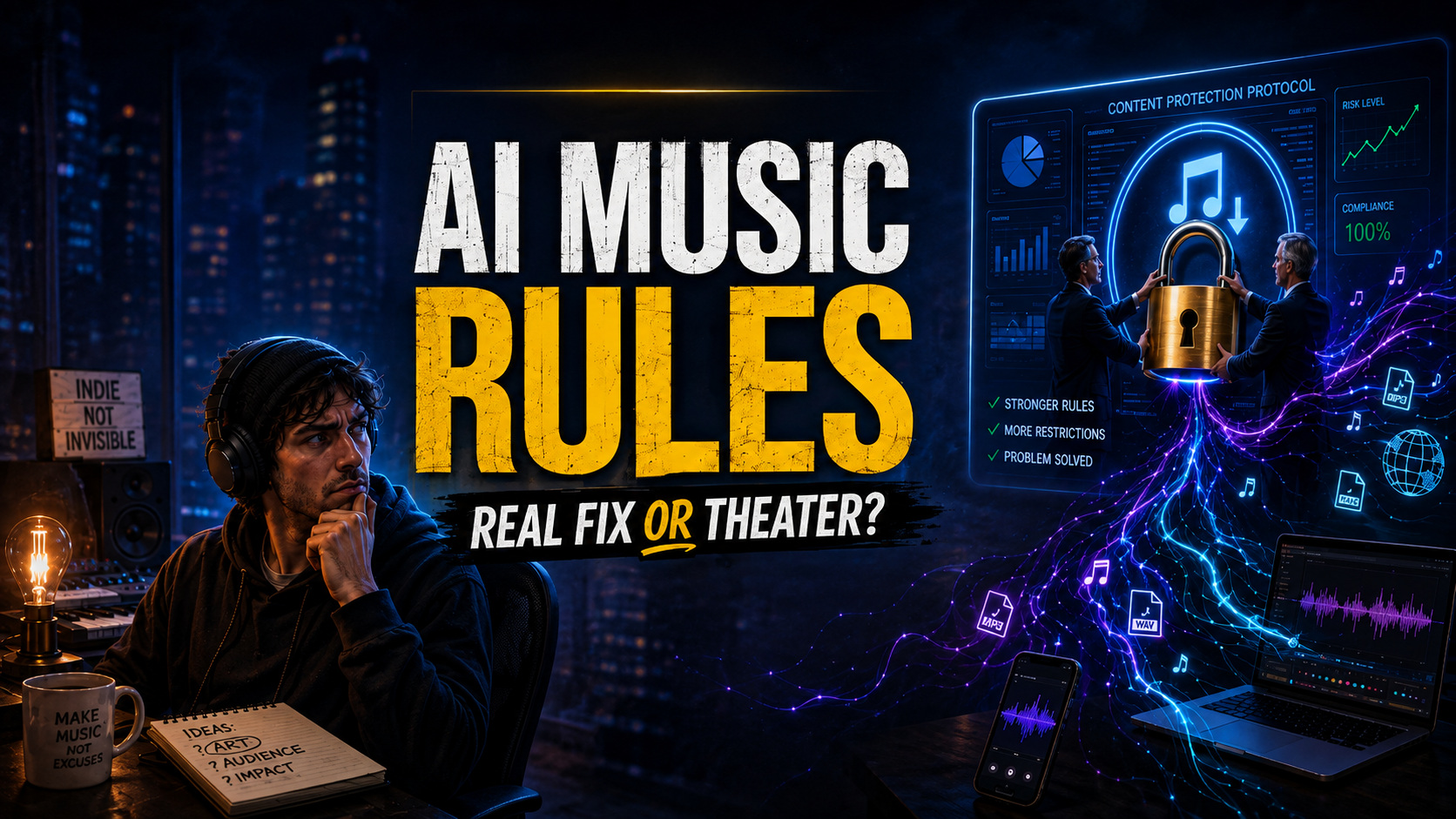
AI Music Rules Are Tightening — But Are They Solving the Wrong Problem?
The music industry has decided AI music needs rules. That part is not surprising. What deserves more scrutiny is whether some of the rules being introduced actually solve the problems they are supposed to solve—or simply make it easier for companies to say they are doing something.
Spotify is adding new AI transparency and identity protections. YouTube requires disclosure of AI-generated music. Deezer is detecting and labeling fully AI-generated tracks and removing them from recommendations. Australia’s ARIA has gone even further, announcing that wholly AI-generated recordings will not qualify for its charts, while music that is considered “substantially human made” can remain eligible. (newsroom.spotify.com)
Then there is Suno. Beginning September 3, 2026, Suno is limiting how many songs most users can download. Free accounts receive seven lifetime trial downloads, Pro subscribers receive 20 per month, and Premier subscribers receive 60. Suno says the change is intended to make it harder for bad actors to mass-export music while encouraging more intentional creation. (suno.com)
That sounds reasonable until you ask a simple question: **does restricting the download button actually stop someone from obtaining music that is already publicly playable?
## A Download Limit Is a Barrier, Not a Lock
There is an important difference between making something harder and making something impossible. Suno’s new policy can absolutely make automated bulk downloading more difficult. That is a legitimate effect. Someone attempting to export thousands of clean files directly from Suno now encounters more friction.
But Suno also says songs remain playable and shareable on the platform, including songs affected by the new download restrictions. Its new Terms specifically prohibit obtaining copies through methods such as stream ripping or recording. (help.suno.com)
The existence of that prohibition illustrates the underlying technical problem. If someone can hear a song, audio has already been delivered to a playback device. Preventing someone from pressing an official Download button does not make the sound itself inaccessible.
A determined person can still capture audio outside the approved workflow. They may violate terms of service by doing it. They may lose quality or metadata. They may expose themselves to enforcement. But the audio did not suddenly become impossible to copy.
That means download restrictions are best understood as friction, not complete protection. And friction has side effects. Legitimate creators still need to move their own music. They archive it, test it elsewhere, distribute it, use external tools, build websites around it, and move finished tracks into other workflows.
When official workflows become more restrictive, users naturally start looking for alternative workflows. That does not mean those users are thieves. It means the demand never disappeared.
The danger is that if legitimate movement of music becomes unnecessarily difficult, companies can unintentionally create stronger incentives for unofficial tools and workarounds—the very ecosystem they were trying to discourage.
## The Industry Has a Real Problem. It Just Isn’t Simply “AI.”
None of this means the music industry is inventing the problem. The scale is real.
Deezer reported in July that it was receiving approximately 90,000 fully AI-generated songs every day, with AI music exceeding 50% of new uploads during peak periods in June. Even more concerning, Deezer says as much as 85% of streams associated with fully AI-generated tracks in 2025 were identified as fraudulent. (newsroom-deezer.com)
Spotify has its own staggering number. The company said in September 2025 that it had removed more than 75 million spammy tracks during the previous twelve months. Its AI policies increasingly focus on unauthorized voice impersonation, deceptive uploads, spam and misleading artist identities. (newsroom.spotify.com)
Those are genuine problems. But notice what they actually are: spam, fraud, impersonation, manipulation and deception.
AI can dramatically increase the scale of those behaviors, but AI itself is not synonymous with any of them. Someone creating one original song with Suno, spending hours rewriting it, editing the arrangement and presenting it to an audience is not doing the same thing as someone automatically uploading 10,000 tracks and manipulating their streams.
Someone creating a fictional AI vocalist is not automatically doing the same thing as someone cloning the voice of an existing artist without permission. Someone using AI to help arrange an original song is not automatically committing fraud.
Treating all of those activities as one problem is where the industry risks building the wrong solution.
## Then We Arrive at “Hybrid” Music
ARIA’s new rule exposes an even more difficult issue. Wholly AI-generated recordings will no longer qualify for its charts. AI-assisted recordings can qualify if they are “substantially human made.” (aria.com.au)
But what does substantially human made actually look like once music leaves the studio?
Consider one musician who writes every lyric but has an AI system build the instrumentation. Another writes lyrics and melody but asks AI to produce the arrangement. Another generates an entire first version with AI, replaces the vocals, rewrites half the lyrics, changes the drums and adds live guitar. Another uses AI only to generate a background vocal.
All four used AI, but they clearly did not use it in the same way.
Now try determining exactly where each one sits on that spectrum by analyzing the final audio file. That is a very different problem.
Detection systems can identify signals associated with AI generation. Platforms can use metadata, provenance information and known characteristics from specific generators. YouTube, for example, can automatically apply AI labels based on its own detection systems, content credentials such as C2PA metadata and creator disclosures. But YouTube also gives creators the ability to correct some automatically applied labels when its systems make mistakes. (support.google.com)
Even YouTube’s music-delivery system recognizes multiple categories: Fully Gen AI, Partly Gen AI, No Gen AI, and unknown. When creators or partners do not disclose that information, YouTube says it may rely on additional signals to make a determination. (support.google.com)
That is not the same as possessing an infallible machine capable of reconstructing exactly how every note in a finished song was created.
## Music Has Always Been More Collaborative Than Its Marketing
There is another uncomfortable question hiding inside this debate: why does the industry suddenly need the public-facing artist to have personally created some undefined percentage of a song before that song feels authentic?
Popular music has never worked that way. Artists have used songwriters, producers, session musicians, beat makers, arrangers, engineers, vocal producers, mixers and mastering engineers for decades. Some performers write everything. Others write almost nothing. Some of the biggest songs in history have had long lists of contributors.
We generally do not listen to a finished song and demand that the person whose face appears on the cover must also have played the bass, programmed the drums, written every lyric and mixed the recording.
A ghostwriter can contribute an enormous amount to a song while the performing artist remains its public identity. AI is legally different from a human songwriter, particularly when questions of copyright and human authorship arise, and that distinction matters. But culturally, the comparison exposes something uncomfortable.
The music business has always accepted assistance. The argument is now becoming an argument over which kinds of assistance count.
Once we accept “hybrid” AI music, the supposedly clean boundary between human music and AI music starts disappearing quickly.
What If We Police the Harm Instead?
This may be the simpler approach.
Instead of trying to answer “How much AI is inside this song?”, ask whether the music was stolen, whether someone’s identity or voice was used without authorization, whether the uploader is manipulating streams, whether an account is flooding the platform with low-effort spam, whether listeners are actually engaging with the music, and whether the creator is participating legitimately in the ecosystem.
Those questions target behavior, and behavior is where the damage actually occurs.
A song being generated with AI does not automatically injure another artist. Stealing another artist’s song does. Using someone’s voice without permission can. Generating fraudulent streams does. Deliberately overwhelming a platform with spam does.
Those are problems worth solving.
FIYA Was Built From a Different Starting Point
FIYA does not have to solve the question of whether an AI creator deserves to exist on the platform. That question was already answered: they do.
FIYA is an AI-first music community and creator toolbox. The goal is not to punish creators for using the technology. The goal is to help them make better music, give that music somewhere to live, and create an ecosystem where participation actually matters.
That does not mean anything goes. There is a major difference between being anti-AI and being anti-abuse.
FIYA can still fight spam, manipulation and meaningless activity without pretending that AI creation itself is the enemy. That philosophy is also behind the FIYA Visibility Score, or FVS.**
Instead of attempting to perform an AI purity test on every creator, FVS is built around visibility, activity and meaningful participation inside FIYA. Creators cannot simply dump music onto the platform endlessly and expect attention. Listening, voting, reviewing, sharing and participating in the community all matter.
FIYA is also taking that participation one step further with FIYAPay. FIYA currently says 100% of platform advertising revenue goes back to eligible active members, including the creators and community members helping the platform grow. (fiyaplatform.com)
That is a fundamentally different question from the one much of the industry is asking.
Instead of “Can we prove you didn’t use too much AI?”, FIYA asks: “Are you actually contributing something people value?”
Maybe We’re Building Security Around the Wrong Door
The music industry should absolutely fight fraud. It should protect artists from impersonation, stop manipulated streams, develop better provenance technology and make mass spam harder.
But we should be careful about pretending that every new restriction solves more than it actually does.
A download limit can make bulk exporting harder. It cannot make publicly playable sound impossible to copy. An AI detector can provide evidence. It cannot necessarily reconstruct the entire creative history of a finished song. A label can improve transparency. It cannot determine whether the music is good. And calling something “hybrid” does not magically solve the question of exactly where the human ends and the machine begins.
The industry is facing a real problem, but it may be building an elaborate security system around the wrong door.
The better future for AI music may not come from endlessly asking whether a song is human enough. It may come from getting much better at distinguishing creation from abuse.
That is the distinction FIYA is betting on. What are your thoughts?