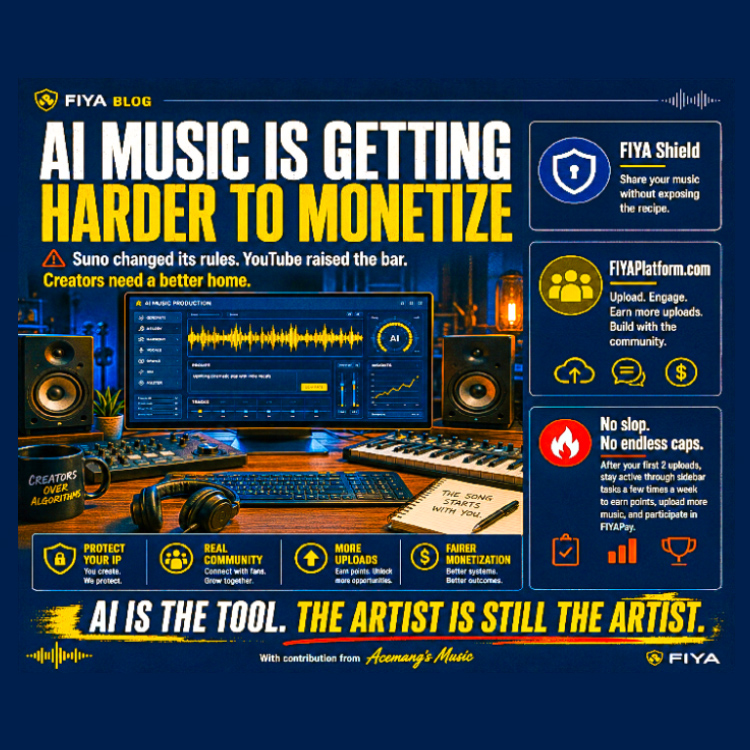
AI Music Is Getting Easier to Create—and Harder to Monetize
Suno is changing how creators access their music. YouTube is raising the bar for new creators to earn advertising revenue. AI music creation may be exploding, but the road from making a song to actually building something from it is getting more complicated.
*With contributions from Acemang’s Music, sharing the perspective of an independent musician using AI as part of a larger creative process.*
There is a strange contradiction happening in AI music right now.
It has never been easier to make music. A creator can write lyrics, record guitar, hum a melody, build a beat, generate vocals, experiment with arrangements and produce multiple versions of a song without needing a traditional studio.
But once that song is finished?
The gates are starting to close.
Suno Is Changing the Deal
On August 10, Suno announced that its upcoming generation of music models is being developed in partnership with the music industry. When those models arrive, every previous Suno model will be retired.
Your existing songs aren't disappearing. Suno says they will remain playable and shareable and can still be used for covers and remixes. But creators who have built their workflow—or even part of their musical identity—around a particular model will eventually have to move forward.
Then there are downloads.
Beginning September 3, 2026, Suno says Free accounts will receive seven lifetime trial downloads, Pro accounts will receive 20 downloads per month, and Premier accounts will receive 60. Premier members working through Suno Studio will remain unlimited, and additional downloads can be purchased.
Suno's reasoning is understandable: mass generation and mass exporting make it easier for bad actors to flood the music ecosystem. The company says the limits are intended to encourage intentional creation rather than bulk exporting.
And that gets to the bigger issue.
Nobody wants AI slop.
Not listeners. Not platforms. Not serious AI musicians. And certainly not FIYA.
But there is a major difference between controlling spam and making legitimate creators continually jump through higher gates.
YouTube Is Raising One of Those Gates Too
YouTube has announced another significant change coming February 1, 2027.
New creators seeking advertising and YouTube Premium revenue sharing through the YouTube Partner Program will need 1,000 subscribers and either 8,000 qualified watch hours during the previous 365 days or 20 million qualified Shorts views within 90 days.
That's double the current watch-hour and Shorts-view requirements. Existing YPP creators aren't being removed because of the new entry threshold, and YouTube's lower requirements for fan-funding and Shopping products remain.
For an established creator, that might not sound terrifying.
For somebody trying to build an audience from zero, it matters.
And for independent AI music creators, it should be another reminder that putting your entire future in the hands of one giant platform is becoming a risky strategy.
AI Is the Tool. The Artist Is Still the Artist.
This is where Acemang’s Music raised an important point in his contribution to this article.
The conversation around AI music too often begins with the assumption that the creator typed a sentence, pressed a button and called themselves a musician.
That simply isn't everyone's process.
Acemang has played drums, recorded guitar, written lyrics, toured with bands and worked with recording equipment long before generative AI existed. Today, AI is another piece of that creative process.
A musician might upload an original guitar recording. Another may start with their own drums, melody, lyrics or decades-old demo. Someone else may use AI to finally hear an arrangement they never had the band, studio or money to produce.
That distinction matters.
AI can generate music. It does not erase the human contribution that may have come before, during and after the generation.
As Acemang put it:
AI is the tool. The creativity is human.
That also means creators need to start acting like owners.
Keep your original WAV files. Keep the stems, MIDI, lyrics, demos, project files, recordings and finished masters. Keep backups outside the platforms you use.
A platform should be part of your workflow.
It should never be the only place your work exists.
The Next AI Music Problem Isn't Creation
We've spent years asking whether AI could make music.
It can.
The harder question now is:
Where does all that music go?
If generation becomes nearly unlimited while discovery remains controlled by a handful of algorithms, we haven't really democratized music. We've democratized production while leaving distribution and monetization behind another gate.
That is the problem FIYAPlatform.com is trying to approach differently.
FIYA isn't pretending unlimited uploading is the solution either.
Because again: we're not taking the slop.
Creators can begin by uploading their first two songs. After that, continued uploading is tied to participation in the community. The tasks already shown in the FIYA sidebar are what members need to complete—things like listening, reviewing, voting and participating.
You don't need to live on FIYA all day.
Do some of them a few times each week.
That activity earns points that can open additional uploading capacity, and eligible activity can also participate in FIYAPay.
The difference is philosophical.
Instead of saying:
Get millions of views and then maybe you matter.
FIYA is saying:
Participate in the community you're asking to participate in your music.
FIYA Doesn't Want an Upload Dump
That distinction is important.
An AI-only music platform with absolutely no friction would eventually create exactly the problem everyone is complaining about: thousands upon thousands of songs uploaded by people who never listen to anyone else.
That's not a community.
That's storage.
FIYA is intentionally being built around interaction. Creators can test songs through FIYA Battle, collect reviews, let listeners choose between versions with Suno 3 Way, build playlists, collaborate, sell directly and create a music page where their work has somewhere to live. FIYA says its ad revenue is returned through FIYAPay to eligible active members based on platform rules, verified activity and available advertising revenue.
There isn't a follower minimum before your participation matters. The system is designed around the idea that creators, listeners, reviewers and voters all contribute value to the ecosystem.
That's a very different model from uploading a song and hoping an algorithm notices you.
And What If You Don't Want Another Platform?
Then don't join one.
Seriously.
There is another problem emerging for Suno creators that has nothing to do with monetization.
Sometimes you simply want to share the song.
Not your workflow.
Not your lyrics.
Not your prompt.
Not the recipe behind how you made it.
That's why FIYA Shield exists.
Shield creates a clean public listening page from a Suno share link. The listener gets the music without the underlying prompt or lyrics being displayed. You confirm that you have the rights to share the music, create the page and send that instead.
And you do not need a FIYA account to use it.
For creators who simply want a cleaner home for sharing their work without exposing everything behind it, that's the point.
Stop Building on Borrowed Ground
Suno isn't the enemy.
YouTube isn't the enemy.
AI isn't the enemy.
These companies are making decisions for ecosystems operating at enormous scale, and some form of quality control is inevitable.
But creators should be paying attention to what those decisions are teaching us.
Models can disappear.
Terms can change.
Downloads can be limited.
Monetization requirements can double.
Algorithms can change tomorrow morning.
The lesson isn't to abandon those platforms.
The lesson is to stop making any one of them your entire strategy.
Keep your originals. Protect your creative process. Build direct relationships with listeners. Give your music a home beyond a generation link. Participate in communities instead of simply feeding algorithms.
And yes, use AI.
Use the hell out of it if it helps you create something worth hearing.
But remember what Acemang’s Music said.
The microphone isn't the singer. The guitar isn't the guitarist. Recording software isn't the musician.
And AI isn't the artist.
The people creating the music—and the people helping that music move—should have a place in the value being created.
That is the direction FIYAPlatform.com is building toward.
Not unlimited slop.
Not upload-and-pray.
Create. Participate. Protect your work. And build together.
What do you think?
Are platforms right to put more limits around AI music, or are legitimate independent creators getting caught in rules designed to stop spam?
Tell us in the comments.